- HR Brain Pickings
- Posts
- 😬 Everyone has AI. Almost no one has ROI.
😬 Everyone has AI. Almost no one has ROI.
Here's why AI investments are stuck in first gear
Howdy HR friends!👋
Hope you’re doing well (or at least making it through your meetings).
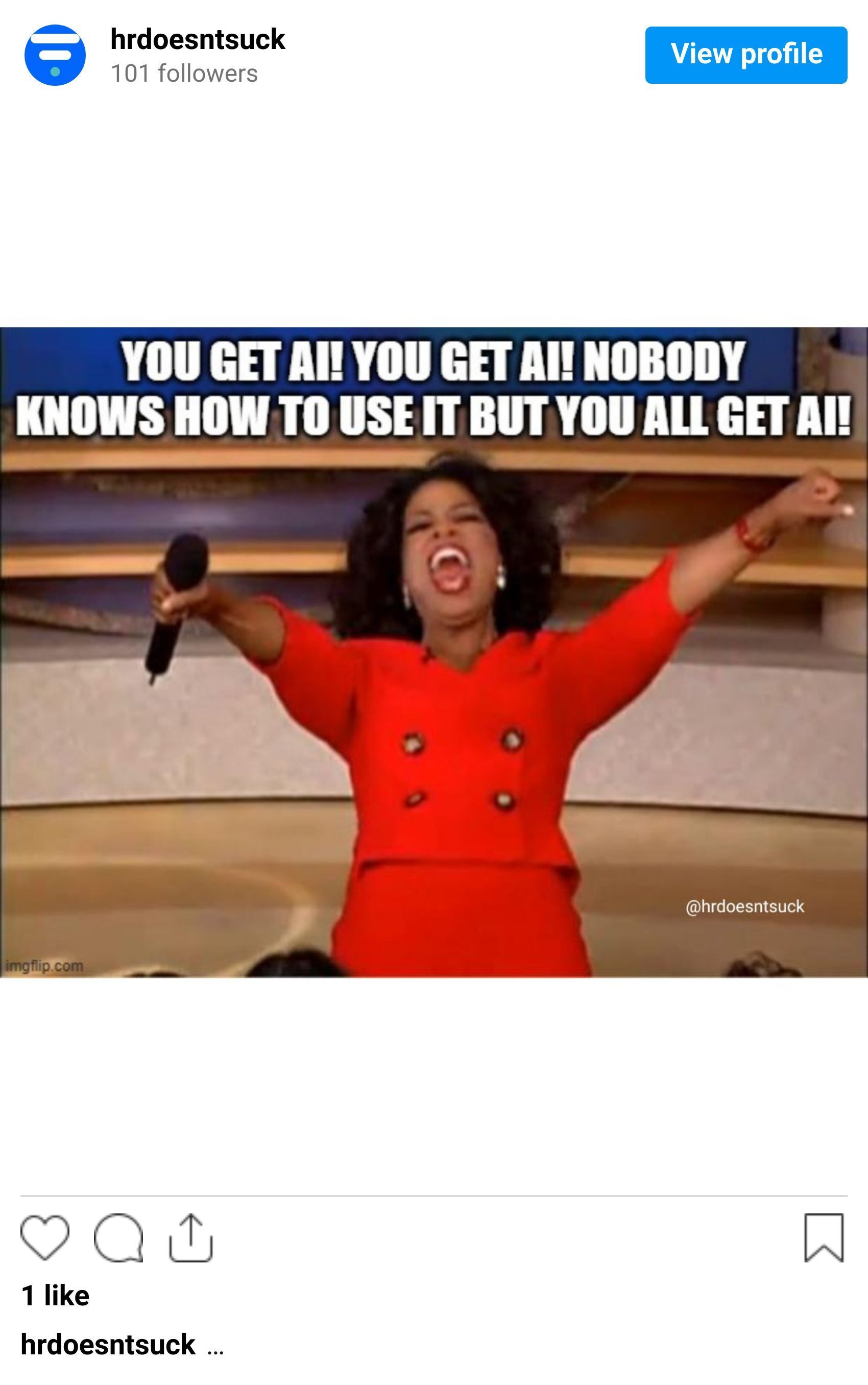
Everyone’s talking about AI right now and chances are your org already rolled out a few tools. But while adoption looks good on paper, real impact is a different story. Most teams are still experimenting, workflows haven’t changed much, and ROI feels… theoretical.
In this edition, we dig into why AI use isn’t translating into results and what HR leaders can do to help move teams beyond basic experimentation.
Today’s edition is presented by SelectSoftware Reviews
Is your current HR tech stack keeping up with how fast AI is changing the way HR teams work? From hiring and engagement to performance and people analytics, new features are rolling out constantly, and figuring out what’s actually worth your time takes serious effort.
SSR’s free HR software matching service helps you make sense of your options by understanding your goals, budget, and priorities, then matching you with HR software that fits — including modern, AI-powered HR tools designed to make everyday work easier.
Bonus: Get a $100 gift card as a thank-you for your time after meeting with your matched vendors.*
*Terms: No purchase necessary. The above offer is for HR leaders in the US, Canada, and other qualifying geographies working at >25 employee count companies who are in market to purchase a new HR software in the next 6 months and want help shortlisting the right vendors for their organization. Referrals qualify for a reward if we are able to introduce them to an HR software vendor.
👇️ Coming up
In today’s edition
😬 Everyone Has AI. Almost No One Has ROI.
🛋️ The Break Room: Is your AI investment actually delivering ROI, or just giving everyone a shiny new toy?
📚 Human Readsources: Immigration enforcement concerns for employers, latest Best Workplace rankings, and a landmark mental health discrimination lawsuit.
💭 Opening thoughts
😬 Everyone Has AI. Almost No One Has ROI.

Well this is awkward.
While AI usage is rising fast, real impact is lagging far behind.
Although over half of workers now use AI weekly, nearly 97% are still using it poorly or not at all in value-driving ways, with fewer than 3% integrating AI meaningfully into their workflows.
Research by McKinsey echoes this disconnect: nearly every company is investing in AI, yet only 1% of leaders say their organization has reached maturity, where AI is fully embedded into day-to-day work and driving measurable outcomes.
This growing gap between adoption and impact is exactly how promising AI investments turn into expensive experiments. More than 85% of employees remain stuck in early stages of AI use, treating it like a smarter search engine or a writing assistant instead of a true collaborator in core work. In other words, lots of clicking, very little transformation.
Closing the AI gap requires moving beyond passive tool rollout and toward intentional, role-specific use cases that solve real talent challenges, from recruiting bottlenecks to manager effectiveness
For easy reading
🧠 Let’s unpick
Most companies have already rolled out AI in some form. People are logging in, experimenting with prompts, and using it to draft emails or summarize documents. On paper, adoption looks healthy.
But when leadership asks what’s actually changed in terms of productivity, hiring outcomes, or day-to-day work, the answers are..unclear. 🤔 That awkward gap between “we have AI” and “AI is helping” is where many organizations are stuck. 😩
The data backs this up.
➡️ Section AI found that while more than half of workers now use AI weekly, nearly 70% are still stuck at the “experimenter” level, using AI mainly for basic tasks, and only a small fraction have integrated it meaningfully into their workflows. Their analysis of thousands of workplace use cases shows that just 15% are likely to generate real ROI. 📈
➡️ BCG research finds a similar pattern, with fewer than 10% of employees reaching the stage where AI actively reshapes workflows through semiautonomous collaboration. 💻️
➡️ And despite nearly universal investment, McKinsey reports that only 1% of companies consider themselves mature in AI, meaning it’s fully embedded into day-to-day work and driving measurable business outcomes. 🤖
➡️ What’s striking is that this isn’t an employee motivation problem. McKinsey found that workers are more ready for AI than leaders assume, and many expect it to take over a meaningful share of their daily tasks in the near future. Yet most organizations still treat AI as a tool rollout rather than a change in how work gets done. Employees are left to experiment on their own, managers aren’t consistently accountable for adoption, and success is often measured by access or activity instead of outcomes. The result is predictable: AI gets used, but mostly at the edges.
For HR leaders, this is the real opportunity. Closing the AI gap is about helping people move from casual use to workflow-level impact. In practice, that looks like:
🎯 Defining role-specific AI use cases instead of leaving everyone to figure it out on their own
🤝 Making time for teams to learn together and share what’s actually working
👩💼 Asking managers to actively support AI adoption in day-to-day work, not just sign off on tools
🔄 Redesigning processes rather than chasing the newest features
⏱️ Tracking outcomes like time saved and friction reduced, not just usage
The organizations seeing progress treat AI as a people transformation, not just a tech upgrade. If HR helps embed it into how work actually happens, results can finally show up.
You can read more at...
🎬 Lights, camera, action!
Takeaway (and try this 👇)
📊 Stop tracking activity. Start tracking impact. Move beyond login counts and tool access. Look instead at outcomes that matter like faster hiring cycles, reduced manual work, or fewer employee queries landing in HR inboxes.
🔍 Pressure-test your current tools. Ask your team which AI tools genuinely make their jobs easier and which ones create extra work through reviews, corrections, or workarounds.
🎯 Get specific with use cases. Focus on role-based applications that solve real problems like screening support, interview prep, employee Q&A, or policy lookups and embed them directly into existing workflows.
🧠 Make learning part of the workday. Don’t expect teams to figure this out on their own time. Set aside dedicated space for experimentation, sharing wins, and building repeatable workflows that go beyond basic prompting.
👥 Turn managers into adoption owners. Ask HR managers to identify where AI can improve their team’s daily work and hold them accountable for turning those ideas into practical solutions.
👀Too long didn’t read
TLDR
Everyone’s using AI, but most companies aren’t seeing real results because it’s stuck in basic, one-off tasks instead of embedded into everyday work. For HR, the opportunity is to shift from tracking logins to driving outcomes by helping teams move past experimentation and into practical, role-specific AI adoption that actually saves time and reduces friction.
☕The break room
What’s your take?
📚 Additional reading
Human Readsources
🧳 Immigration Crackdown Sparks Fear Among Employers (HR Dive) - Immigration crackdown creates chaos for employers' workforce plans.
🏢 Top 100 Workplaces: Crew Carwash Leads 2026 Rankings (The HR Digest) - Glassdoor reveals Crew Carwash tops 2026 Best Places list.
🧠 Google Sued: Mental Health Disclosure Used Against Employee (HCA Mag) - Google employee sues over manager's misuse of mental health disclosure.
That’s it for today.
Thanks for reading to the end and we hope today’s edition sparked some new ideas for your workplace! 🧠
We know you’re super busy and really appreciate you saving some room for us in your inbox 😀
On a scale of 1 to HR, how much do you like this edition? |
Reply